Airynee Chicken Coops Built for Real Flocks
These large-run coops are designed for backyard keepers who've outgrown small prefab hutches and need a structure that handles serious flock sizes, real weather, and real predators. Both configurations fit up to 40 chickens, use a galvanized steel frame with PVC-coated hexagonal wire mesh, and include a UV-resistant waterproof cover — the main difference is footprint and roof shape. If you're planning for a mid-to-large flock and want something that doesn't need to be replaced after one hard winter, this is the line to consider.

Both Configurations Side by Side
Spire Roof Coop Large Flock
See on Amazon
Dome Roof Coop Mid Flock
See on AmazonSee more products
Discover the full product lineup with current selection on Amazon.
All products on AmazonConfiguration Specs at a Glance
Both coops share the same width, height, wire mesh, frame material, and capacity — the table below shows where they differ and which setup suits which situation.
| Model | Dimensions (L × W × H, inches) | Roof Style | Chicken Capacity | Best For |
|---|---|---|---|---|
| Spire Roof (B0H299H48C) | 314.4 × 117.6 × 79.2 | Spire (peaked ridge) | Up to 40 | Large flocks with room to roam; yards where square footage isn't the constraint |
| Dome Roof (B0FKGYRCSJ) | 157.2 × 117.6 × 79.2 | Dome (rounded profile) | Up to 40 | Smaller yards or flocks that free-range and use the run mainly for shelter and overnight security |
If your yard can fit the Spire Roof's 26-foot footprint and you're housing close to 40 birds, it's the better pick for flock welfare — more ground space per bird means less stress and easier cleaning. If you're working with a tighter space or a smaller flock, the Dome Roof delivers the same core protection in half the footprint.
Choosing Between the Spire Roof and Dome Roof
The core specs are identical between these two models — same wire mesh, same frame material, same door system, same 40-chicken capacity, same 117.6 × 79.2 inch width and height. The decision comes down to one thing: how much length you have and how you want to use the run space.
The Spire Roof model measures 314.4 inches long — that's just over 26 feet. The Dome Roof model measures 157.2 inches, just over 13 feet. If your yard has the room, the Spire Roof gives your flock nearly twice the ground space, which matters for welfare, pecking order, and how frequently you're mucking out the run. For 40 birds, more square footage is genuinely better — 40 chickens in a 13-foot run is a tight fit even if the spec supports it. The Dome Roof is the right call when you're working with a constrained backyard, an HOA setback, or a flock that spends time free-ranging and uses the run mainly for shelter and night containment.
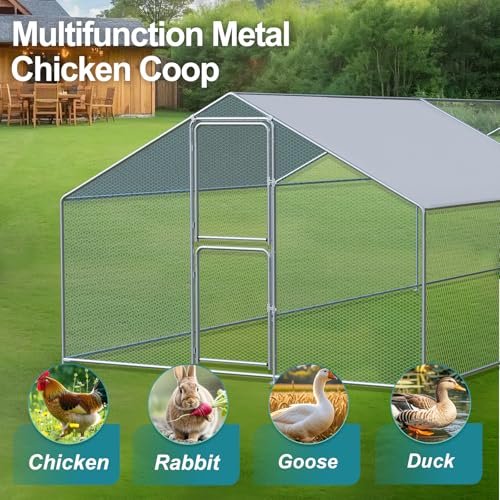
The roof shape also affects water and snow behavior slightly. A spire roof sheds precipitation along a sharper ridge line, which can keep the cover drier over a long run. The dome profile disperses runoff more evenly across a shorter span. Both use the same UV-resistant waterproof cover material — neither is dramatically better in rain, but the spire design has a slight structural advantage in heavy snow load because the peaked geometry distributes weight toward the frame edges.
What a Run This Size Actually Looks Like in Use
A 40-chicken coop at this scale is a genuine outdoor structure — not a backyard decoration. The Spire Roof footprint at 314.4 × 117.6 inches is roughly 26 feet long and just under 10 feet wide. You'll want a flat or near-flat area, access on at least one side for cleaning, and a plan for where the door faces relative to your daily routine. Double lockable doors are included; consider which direction you want them to face before you stake the ground.
The L-shaped ground locks are designed to anchor the frame to the soil and deter digging predators — raccoons, foxes, and dogs are the most common threats in suburban and semi-rural settings. Install them as designed, pressed into the ground along the perimeter. Skipping this step defeats the purpose of the wire mesh, since most predator entries happen from underneath, not through the sides.
- For a 20–30 bird flock that free-ranges during the day: the Dome Roof model gives secure nighttime containment and run access without taking over the yard.
- For a 30–40 bird flock that spends significant time in the run: the Spire Roof model gives enough space that birds aren't crowded during the hours they're confined — which reduces stress, feather-pecking, and disease pressure.
- For first-time keepers upgrading from a small coop: size up rather than down. A run that feels oversized in year one will feel appropriately sized once your flock matures or you add a few birds.
Both models include a cover, but neither ships with a pre-built enclosed sleeping house inside the run. If your flock needs a fully enclosed roosting section, plan for an interior coop box or attached house — the run itself is an open-air wire structure with a covered roof, not a fully enclosed building.
Keeping the Coop Secure and Weather-Ready
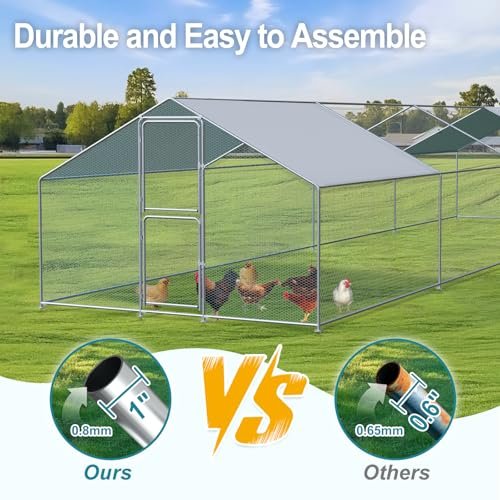
The galvanized steel frame and powder-coat finish resist rust for extended outdoor use — but "resist" is not the same as "immune." After the first winter, check the frame joints and any areas where water pools or mud splashes regularly. If you see surface rust beginning at connection points, treat it early with a rust-inhibiting spray. The frame itself won't fail quickly, but neglected surface corrosion at joints shortens the structure's life.
The PVC-coated hexagonal wire mesh is meaningfully different from basic chicken wire. Chicken wire is thin, twistable, and can be pulled open by a determined raccoon. The hex mesh on these coops is rigid and coated — it's not predator-proof, but it is predator-resistant in a way that standard wire is not. Inspect the mesh once or twice a year for any areas where the coating is damaged or the wire has been bent. Damage at ground level near the L-shaped locks is the most common wear point and the most important to address.
- Double-check the L-shaped ground locks at the start of each season. Frost heave and soil settling can shift the perimeter anchors out of position over winter.
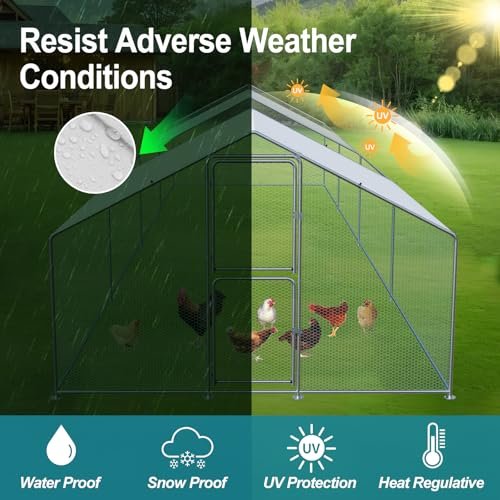
- Clear snow off the cover after heavy accumulation. The UV-resistant PE cover sheds rain well, but extended heavy snow load is more stress than any fabric cover is designed for. A light push with a broom from outside the frame is enough.
- Lubricate the door locks before winter. Double lockable doors in cold climates can stiffen or jam if the metal isn't maintained. A basic silicone spray applied to the latch mechanism in fall prevents most of this.
- Always verify the double locks are engaged at night. Raccoons are capable of opening simple single latches — the double lockable door design is there for a reason, and it only works if both locks are set.
Frequently Asked Questions
Is 40 chickens a realistic number or just a marketing spec?
It's a realistic upper limit, not a recommended stocking density. Most experienced flock keepers run better welfare outcomes — less feather-pecking, lower disease pressure, easier management — at 60–70% of rated capacity. That puts the practical sweet spot around 25–28 birds for either model. If you're housing 40 large breeds like Buff Orpingtons or Jersey Giants, expect it to feel crowded unless they're spending the majority of their time free-ranging and using the run mainly for confinement. For 40 standard-sized birds that range freely during the day, it's a workable number.
Does this coop come with an enclosed sleeping house, or is it just a run?
It's a run — a large covered wire enclosure, not a fully enclosed sleeping house. The UV-resistant waterproof cover provides weather protection over the run space, and the frame is fully enclosed in wire mesh. But there's no built-in roosting house with solid walls and a pop door. If your flock needs an enclosed structure for overnight roosting, you'll need to add an interior coop box or attach a separate enclosed house to this run. This is standard for large run systems at this scale — the run is the secure outdoor enclosure, and the house is a separate component.
How effective are the L-shaped ground locks against digging predators?
They're a meaningful deterrent when properly installed. The L-shaped design creates a physical barrier along the perimeter that a digging animal hits before it can tunnel under the wire wall. Raccoons, foxes, and dogs — the most common backyard flock threats — are significantly slowed by a correctly staked perimeter. Install the locks pressed firmly into the soil around the full perimeter, not just at corners. For areas with particularly persistent diggers, some keepers add a layer of hardware cloth or paver stones along the outer edge as additional reinforcement — the L-locks are not predator-proof on their own, but they're the right starting point.
How long does assembly take, and can one person do it?
A coop at this size — particularly the Spire Roof at 26 feet long — is a two-person job. One person can manage some stages, but the frame sections and cover installation are genuinely easier and safer with a second set of hands. Budget a full afternoon for the Spire Roof model, and don't start without confirming you have all hardware accounted for before you begin. The Dome Roof is shorter and slightly more manageable, but still benefits from help. Airynee includes 3D graphic assembly instructions with the coop — go through them completely before you pick up a tool, because the sequence matters with large modular frame systems.
Will the cover hold up through a hard winter?
The UV-resistant PE cover is designed to shed rain and resist UV degradation over time — it's the same material category used on greenhouse covers and shade structures. It handles normal precipitation well. What it isn't designed for is sustained heavy snow load sitting on the surface. After significant snowfall, clear the cover with a light push of a broom from outside the frame — don't let accumulation sit. The spire roof's peaked profile sheds snow better than a flat surface, which is a mild advantage in snow-heavy climates. The underlying galvanized steel frame and powder-coat finish handle cold and moisture without issue; the cover is the component that needs seasonal attention.
What's the difference between PVC-coated hex mesh and regular chicken wire, and does it actually matter?
It matters significantly for predator resistance. Standard chicken wire is thin-gauge, twisted (not welded), and can be pulled apart or bent open by a determined raccoon or dog. The PVC-coated hexagonal wire mesh used on these coops is heavier gauge, the PVC coating resists rust and adds rigidity, and the hexagonal pattern provides a tighter, more consistent cell size than twisted chicken wire. A raccoon that grabs chicken wire can work it open over time; a raccoon that grabs rigid coated hex mesh mostly can't. This is one of the specs that actually changes the safety outcome for your flock — not just a material upgrade for appearance.